TGLF
MITIM can be used to run the TGLF model, interpret results, plot relevant quantities and perform scans and transport analyses. This framework does not provide licenses or support to run TGLF, therefore, please see Installation for information on how to get TGLF working and how to configure your setup.
Once setup has been successful, the following regression test should run smoothly:
python3 MITIM-fusion/tests/capability_tests/tglf_02_run_from_tglfinput.py
Plot TGLF results
MITIM provides comprehensive utilities to interpret the results of TGLF simulations.
As will be detailed in TGLF aliases, we can use the mitim_plot_tglf alias to plot TGLF results that exist in folder tglf_run/:
mitim_plot_tglf tglf_run/
Running this will open an interactive python session and show a comprehensive notebook with all the relevant TGLF outputs:

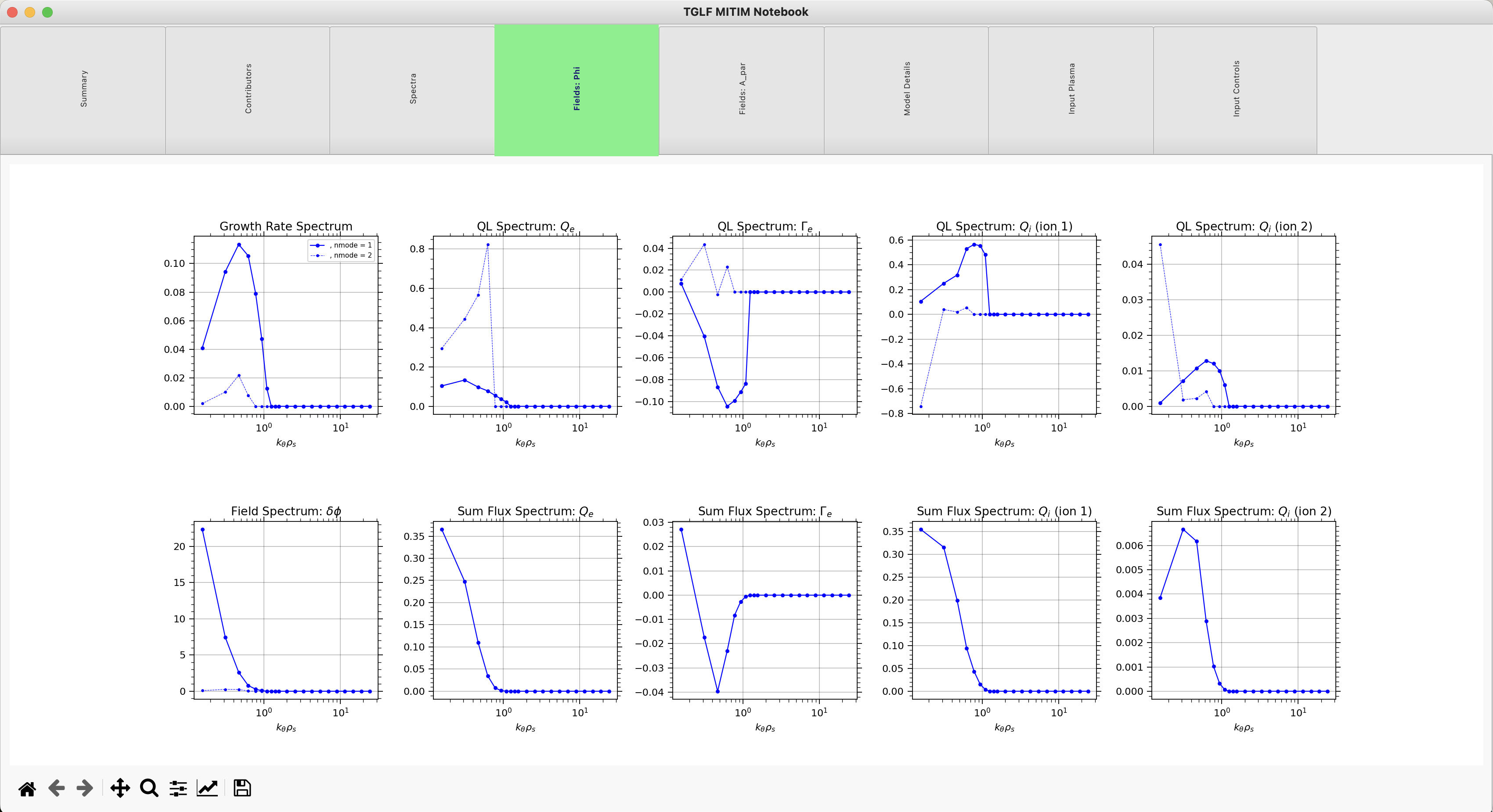
The results can be accessed from the tglf.results dictionary.
Run TGLF from input.gacode
For this tutorial we will need the following modules:
from pathlib import Path
from mitim_tools.gacode_tools import TGLFtools
Select the location of the input.gacode file to start the simulation from. You should also select the folder where the simulation will be run:
inputgacode_file = Path('MITIM-fusion/tests/data/input.gacode')
folder           = Path('MITIM-fusion/tests/scratch/tglf_tut')
The TGLF class can be initialized by providing the radial location (in square root of normalized toroidal flux, rho) to run. Note that the values are given as a list, and several radial locations can be run at once:
tglf = TGLFtools.TGLF(rhos=[0.5, 0.7])
To generate the input files (input.tglf) to TGLF at each radial location, MITIM needs to run a few commands to correctly map the quantities in the input.gacode file to the ones required by TGLF. This is done automatically with the prep() command. Note that MITIM has a only-run-if-needed philosophy and if it finds that the input files to TGLF already exist in the working folder, the preparation method will not run any command, unless a cold_start = True argument is provided.
_ = tglf.prep(inputgacode_file,folder,cold_start=False)
Now, we are ready to run TGLF. Once the prep() command has finished, one can run TGLF with different settings and assumptions.
That is why, at this point, a sub-folder name for this specific run can be provided. Similarly to the prep() command, a cold_start flag can be provided.
The set of control inputs to TGLF (saturation rule, electromagnetic effects, basis functions, etc.) are provided following the following sequential logic:
Each code has a set of default settings, which for TGLF are specified in
templates/input.tglf.controls. This is the base namelist of settings that will be used if no other specification is provided.Then, a
code_settingsargument can be provided to therun()command. This argument refers to a specific set of settings that are specified intemplates/input.tglf.models.yaml, and that will overwrite the default settings ininput.tglf.controls.Finally, an
extraOptionsargument can be provided to therun()command, which is a dictionary of specific settings to change from the previous two steps.
For example, the following two commands will run TGLF with saturation rule number 2 with and without electromagnetic effets. After each run() command, a read() is needed, to populate the tglf.results dictionary with the TGLF outputs (label refers to the dictionary key for each run):
tglf.run( subfolder = 'yes_em_folder',
          code_settings  = 'SAT2',
          extraOptions  = {'USE_BPER':True},
          cold_start       = False )

tglf.read( label = 'yes_em' )

tglf.run( subfolder = 'no_em_folder',
          code_settings  = 'SAT2',
          extraOptions  = {'USE_BPER':False},
          cold_start       = False )

tglf.read( label = 'no_em' )
Tip
In this example, tglf.results['yes_em'] and tglf.results['no_em'] are themselves dictionaries, so please do .keys() to get all the possible results that have been obtained.
TGLF results can be plotted together by indicating what labels to plot:
tglf.plot( labels = ['yes_em', 'no_em'] )
As a result, a TGLF notebook with different tabs will be opened with all relevant output quantities:

Run TGLF from TRANSP results file
Deprecated since version 5.0: The prep_using_tgyro() method used in this workflow is deprecated and will be removed in a future release.
Consider preparing an input.gacode file separately and using the standard prep() workflow described in the previous section.
If instead of an input.gacode, you have a TRANSP .CDF file (cdf_file) and want to run TGLF at a specific time (time) with an +- averaging time window (avTime), you must initialize the TGLF class as follows:
from pathlib import Path
from mitim_tools.gacode_tools import TGLFtools

cdf_file = Path('MITIM-fusion/tests/data/12345.CDF')
folder   = Path('MITIM-fusion/tests/scratch/tglf_tut')

tglf     = TGLFtools.TGLF(  cdf    = cdf_file,
                            rhos   = [0.5,0.7],
                            time   = 2.5,
                            avTime = 0.02 )
Similarly as in the previous section, you need to run the prep() command, but this time you do not need to provide the input.gacode file:
cdf = tglf.prep_using_tgyro(folder,cold_start=False)
Note
The .prep_using_tgyro() method performs two extra operations:
TRXPL (https://w3.pppl.gov/~hammett/work/GS2/docs/trxpl.txt) to generate plasmastate.cdf and .geq files for a specific time-slice from the TRANSP outputs.
PROFILES_GEN to generate an input.gacode file from the plasmastate.cdf and .geq files. This file is standard within the GACODE suite and contains all plasma information that is required to run core transport codes.
The rest of the workflow is identical to the previous section, including .run(), .read() and .plot().
Run TGLF from input.tglf file
If you have a input.tglf file already, you can still use this script to run it.
from pathlib import Path
from mitim_tools.gacode_tools import TGLFtools

inputgacode_file = Path('MITIM-fusion/tests/data/input.gacode')
folder           = Path('MITIM-fusion/tests/scratch/tglf_tut')
inputtglf_file   = Path('MITIM-fusion/tests/data/input.tglf')

tglf = TGLFtools.TGLF()
tglf.prep_from_file( folder, inputtglf_file, input_gacode = inputgacode_file )
The rest of the workflow is identical, including .run(), .read() and .plot().
Tip
The provision of an input.gacode file as in the example above is not necessary. However, if no input.gacode file is provided, MITIM will not be able to unnormalize the TGLF results.
Tip
Once the TGLF class has been prepared, if the results exist already in the folder, .run() is not needed and results can be read and plotted:
from pathlib import Path
from mitim_tools.gacode_tools import TGLFtools

folder           = Path('MITIM-fusion/tests/scratch/tglf_tut/yes_em_folder')
inputtglf_file   = Path('MITIM-fusion/tests/data/input.tglf')

tglf = TGLFtools.TGLF()
tglf.prep_from_file( folder, inputtglf_file )
tglf.read (folder = f'{folder}/', label = 'yes_em' )
tglf.plot( labels = ['yes_em'] )
Please note that the previous code will only work is TGLF was run using MITIM. This is because MITIM stores the results
with a suffix that indicates the radial location (rho) where the run was performed.
If you want to read results from a TGLF run that was not performed with MITIM, you can provide the suffix specification
to the .read() method, including None:
tglf.read (folder = f'{folder}/', suffix = None, label = 'yes_em' )
Run 1D scans of TGLF input parameter
Under Development
(In the meantime, please checkout the standalone teaching scripts in tests/capability_tests/ )
TGLF aliases
MITIM provides a few useful aliases, including for the TGLF tools: Shell Scripts